| Date | May 2026 |
| Event | 2026 Minneapolis Incident |
| Causes | Police shooting, protests over police brutality and systemic racism |
| Outcome | Widespread violence, property destruction, heavy-handed government response, national debates on policing and civil rights |
| Location | |
| Aftermath | Continued to reverberate through American politics and society |
The 2026 Minneapolis Incident was a series of civil disturbances and protests that took place in the city of Minneapolis, Minnesota, United States from May 15-25, 2026. The unrest was sparked by a controversial police shooting but quickly spiraled into widespread violence, property destruction, and clashes between demonstrators and law enforcement. The incident became a major flashpoint for national debates around issues of police brutality, systemic racism, and the limits of government power.
The immediate trigger for the protests was the May 13th police shooting of 32-year-old Jamal Malik, a Black man, during a traffic stop in the Uptown neighborhood of Minneapolis. According to police reports, officers stopped Malik for an expired vehicle registration and the encounter escalated when he allegedly refused to comply with orders and reached into his vehicle. Two officers on the scene fired multiple shots, killing Malik.
Malik's death sparked outrage in the Minneapolis Black community, who alleged a pattern of disproportionate use of force by police against people of color. Protesters quickly organized demonstrations demanding accountability for Malik's killing and broader reforms to policing in the city. This occurred against a backdrop of rising racial tensions and economic inequalities that had simmered in Minneapolis for years.
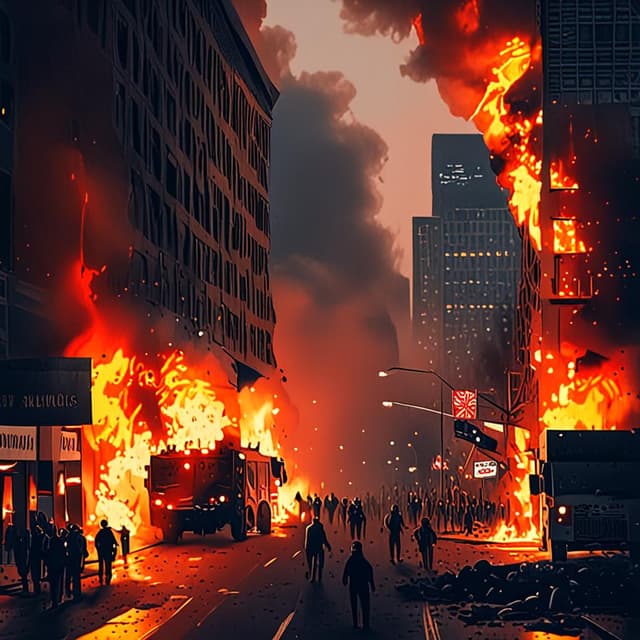
On May 15th, several thousand protesters gathered in downtown Minneapolis to march and hold rallies condemning Malik's death. However, the situation quickly escalated as a smaller group of demonstrators began vandalizing storefronts, setting fires, and clashing with police. Law enforcement responded with teargas, rubber bullets, and mass arrests, further inflaming the crowd.
Over the next several days, the unrest spread across Minneapolis, with protests, riots, and looting occurring in multiple neighborhoods. Rioters targeted symbols of authority and commerce, including police stations, government buildings, and major retail chains. At least 4 protesters were killed in confrontations with police, while dozens of officers and civilians were injured.
Faced with the deteriorating situation, the Governor of Minnesota requested assistance from the federal government. On May 20th, President Sarah Jackson ordered the deployment of National Guard troops to Minneapolis to help restore order. However, the heavy-handed military response, including the use of APCs, riot control agents, and surveillance drones, further galvanized protesters who saw it as an excessive show of force.
The 2026 Minneapolis Incident lasted 10 days before the National Guard and local police were finally able to regain control of the city. In total, at least 20 people were killed, over 500 were injured, and an estimated $500 million in property damage was inflicted. Hundreds of protesters and dozens of police officers were arrested.
The fallout from the unrest reverberated nationally. Politicians, pundits, and the public were sharply divided over issues like the use of force, the causes of the riots, and the appropriate role of government in maintaining public order. Some saw the crackdown as necessary to restore stability, while others condemned it as heavy-handed and a violation of civil liberties.
The incident fueled a broader national reckoning on policing, race relations, and the scope of government power. It also had lasting political consequences, becoming a key issue in the 2028 presidential election. The aftershocks of the 2026 Minneapolis Incident continued to shape American discourse and policy debates for years to come.
